This paper presents a single-demonstration Learning from Demonstration (LfD) framework for imitating spatially ambiguous trajectories, including motions with self-intersections, reversals, and stopping behaviors. Existing approaches based on Dynamical Systems or Dynamic Movement Primitives typically either fail to reproduce such ambiguous trajectories or rely on fixed time parameterizations, making them sensitive to variations in execution speed and unsuitable for compliant human-robot interaction because task progress can become desynchronized from the executed motion. To address these limitations, we propose a phase-modulated dynamical system. The key idea is to introduce a phase-evolution law that synchronizes task progress with the executed motion, thereby making the system time-invariant. We show that the proposed system (i) exactly reproduces the demonstrated motion when initialized on the demonstrated trajectory, (ii) guarantees exponential convergence to the demonstrated trajectory from off-trajectory initial conditions, and (iii) remains robust to perturbations while preserving trajectory topology. Rigorous theoretical analysis establishes these properties, and experimental results demonstrate stable and compliant behavior under execution-speed variations and external interventions.
Dynamical System (DS) is being a standard choice for Learning from Demonstrations (LfD). It is reactive, time-invariant, and offers stability by construction which makes itself suitable for human-robot collaboration.
However, since the velocity field depend only on the current position, it has one critical limitation: it cannot represent spatial ambiguity.
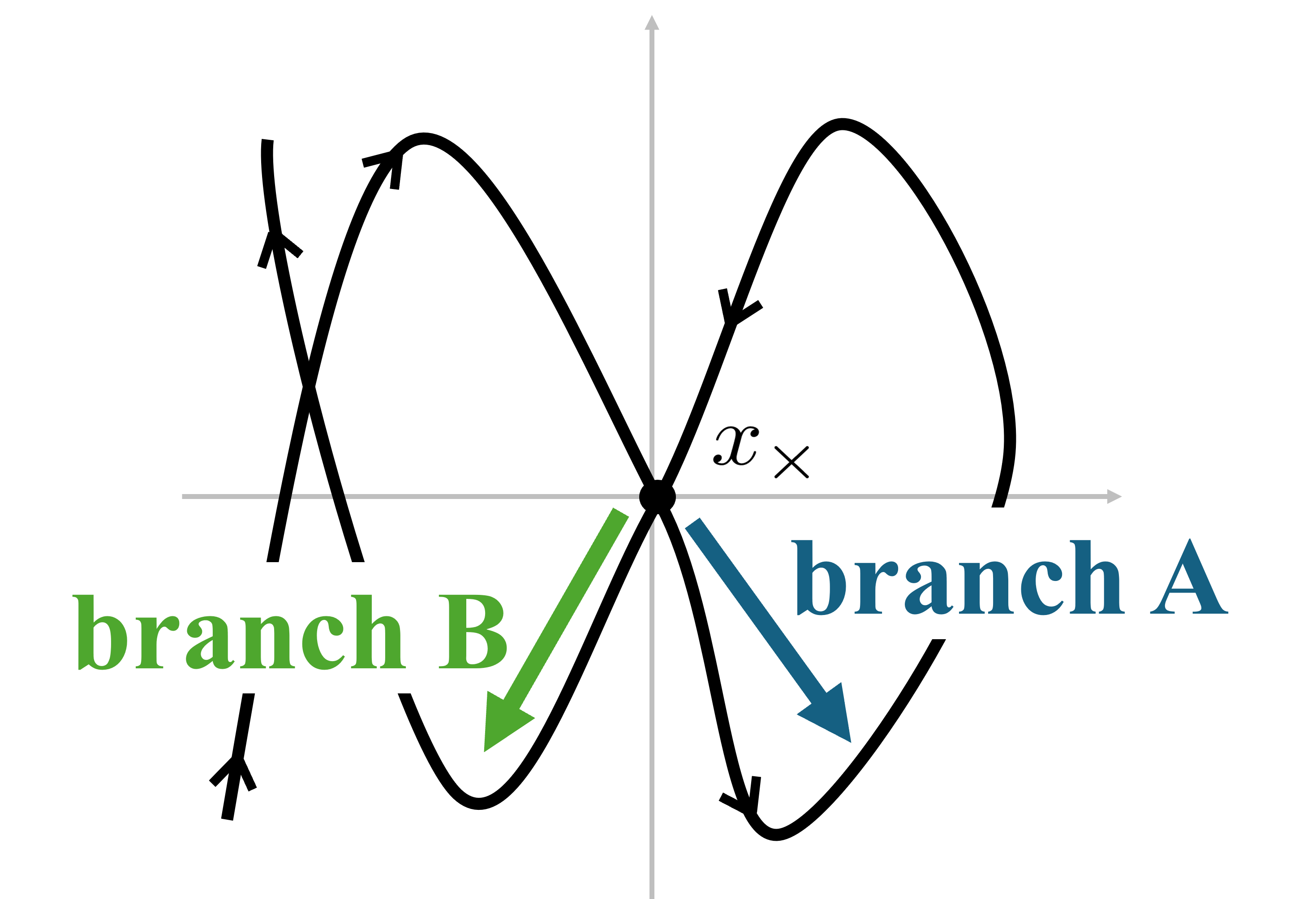
(a) One position, different motion directions.
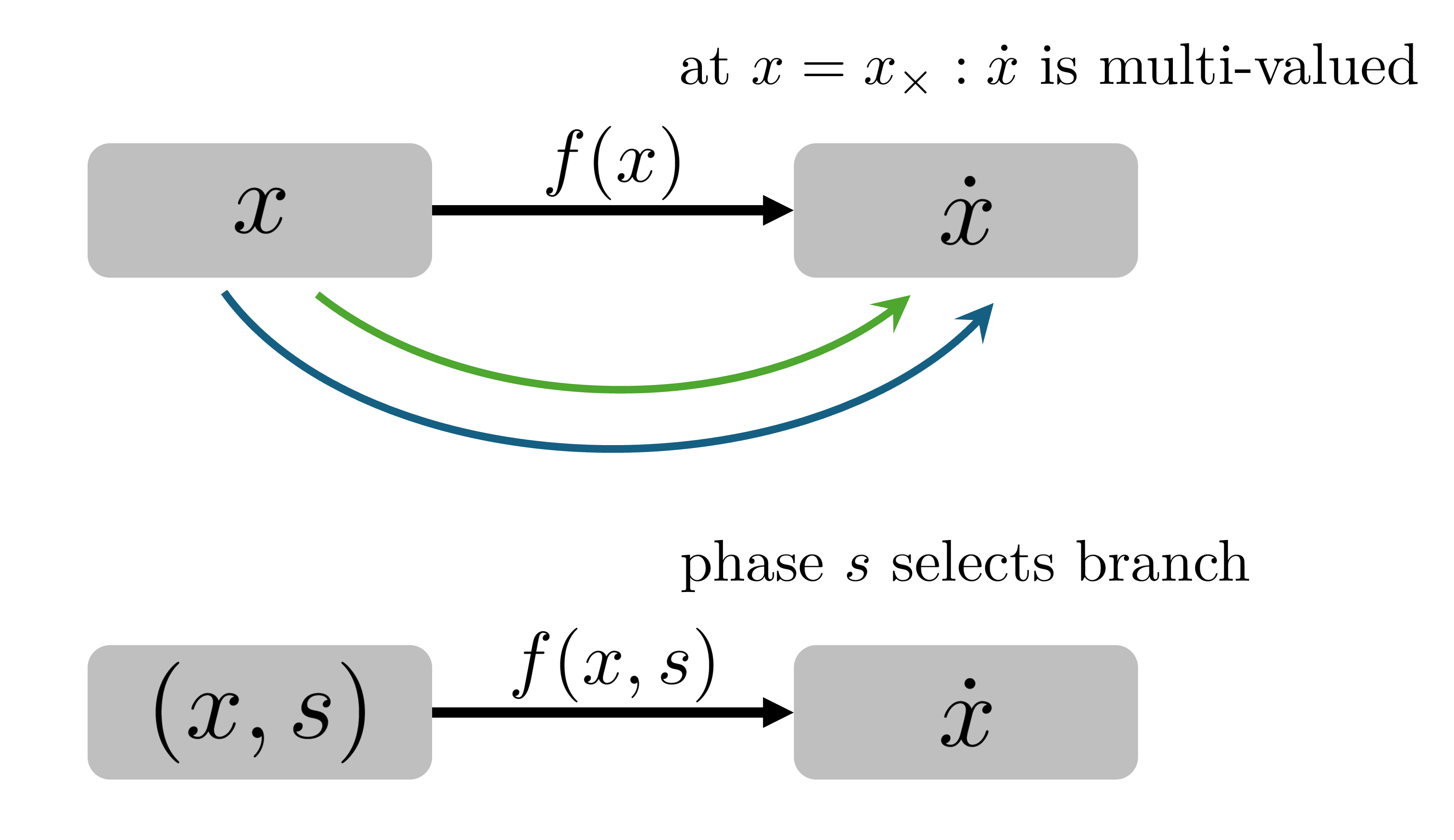
(b) Phase selects the intended branch.
To solve this, we propose the Phase-Modulated Dynamical System (PMDS).
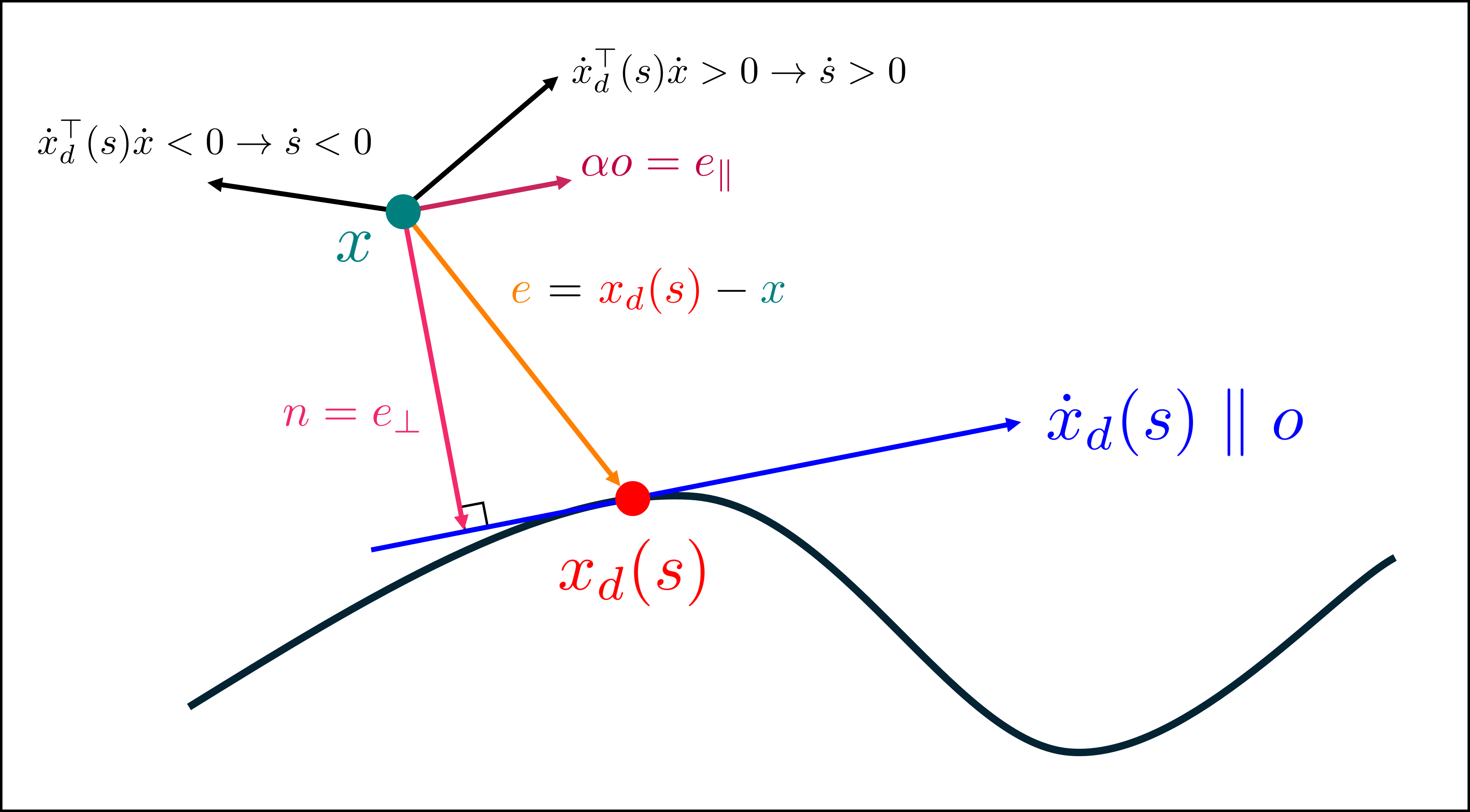
Given a demonstration $X_d:[0,T]\to SE(3)$, PMDS computes the desired body twist $\text{gvf}(t)$ from the task pose $X(t)$ and phase $s(t)$:
The gain $k$ controls attraction strength without directly advancing phase.
Mimicking follows the tangent; contraction reduces transverse error.
Phase evolves from the realized body twist $\mathcal{V}(t)$, using $\langle x,y\rangle_W=x^T W y$ with $W\succ0$:
\[\dot{s}(t) = \begin{cases} \dfrac{\langle \text{mvf}(t),\mathcal{V}(t)\rangle_W}{\langle \text{mvf}(t),\text{mvf}(t)\rangle_W}, & \text{mvf}(t)\ne 0,\\[4pt] 1, & \text{mvf}(t)=0. \end{cases}\]For $\text{mvf}(t)\ne 0$, faster forward motion advances phase faster, holding freezes it, and reverse motion moves it backward. At a demonstrated stop ($\text{mvf}(t)=0$), phase advances at unit rate to complete the recorded dwell. The law has no explicit wall-clock dependence.
Under the paper’s continuous-time modeling and regularity assumptions:
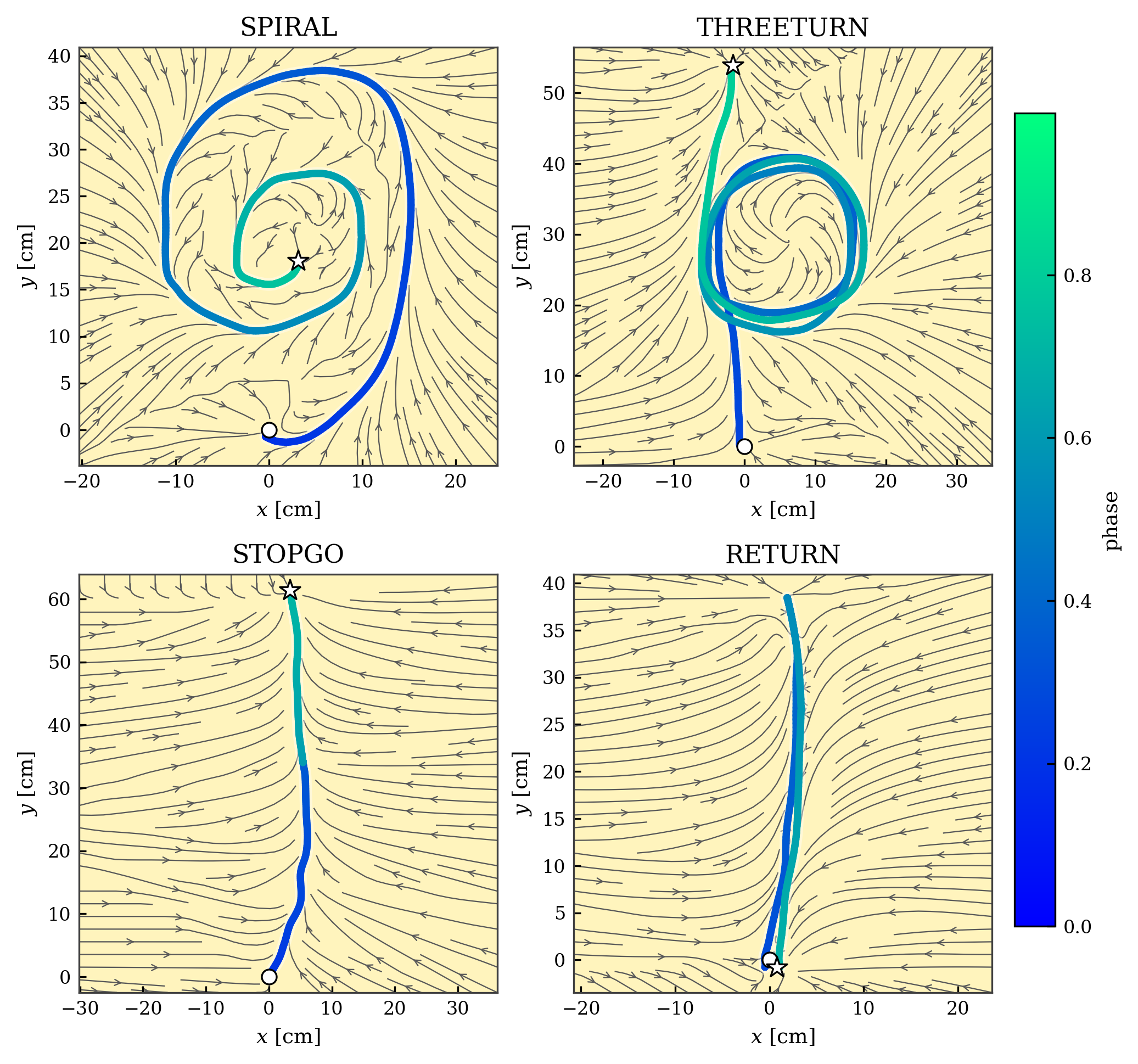
Four SE(3) demonstrations, projected onto the x-y plane and colored by phase.
| Benchmark | Motion to reproduce |
|---|---|
| SPIRAL | A smooth spiral without spatial ambiguity. |
| THREETURN | Three turns with self-intersections, then an exit. |
| STOPGO | A three-second dwell, then resumed motion. |
| RETURN | Outward and return motions through the same positions. |
PMDS ($k=1,3$) is compared with BCSDM, MPDS, SF-GVF, an SE(3) DMP, and GDMP.
PMDS preserves task behavior in both perturbation conditions on every benchmark, at both tested gains. Each cell reports successful outcomes out of the two tested conditions (Fig. 4 of the paper).
| Method | SPIRAL | THREETURN | STOPGO | RETURN |
|---|---|---|---|---|
| BCSDM | 2/2 | 1/2 | 0/2 | 1/2 |
| MPDS | 1/2 | 1/2 | 0/2 | 1/2 |
| SF-GVF | 1/2 | 1/2 | 2/2 | 1/2 |
| DMP | 1/2 | 0/2 | 2/2 | 2/2 |
| GDMP | 1/2 | 1/2 | 2/2 | 1/2 |
| PMDS, k = 1 | 2/2 | 2/2 | 2/2 | 2/2 |
| PMDS, k = 3 | 2/2 | 2/2 | 2/2 | 2/2 |
@ARTICLE{11685323,
author={Jung, Hyunseo and Kim, Jonghyeok and Kim, Keehoon},
journal={IEEE Robotics and Automation Letters},
title={Learning Spatially Ambiguous Trajectories From Demonstrations via Phase-Modulated Dynamical Systems},
year={2026},
volume={11},
number={11},
pages={12663-12670},
keywords={Trajectory;Timing;Dynamical systems;Learning (artificial intelligence);Convergence;Modeling;Robots;Vectors;TV;Chromium;Learning from demonstrations;dynamical systems;path-following control},
doi={10.1109/LRA.2026.3732892}}